CFSA’s Internal Child Fatality Report leaves out more than half of dead children known to system

On September 10, 2020, the Child and Family Services Agency (CFSA) released its internal child fatality review report for 2019. This report raises many issues and concerns. Some relate to the scope and coverage of the report. Others concern the cause and manner of death, the existence of families with repeated CFSA involvement that nevertheless have a child death, the predominance of large families as a correlate of child deaths, and the suggestion that unrelated adults in the home may have perpetrated a child fatality.

Child fatality review is an important way for an agency to assess the quality of its work. CFSA states in the report that “the fatality review process is one of CFSA’s strategies for examining and strengthening child protective performance. It provides the Agency with specific information that helps to address areas in need of improvement and to identify any systemic factors that require citywide attention–all with the goal of reducing preventable child deaths.” But the goal of child fatality review should be broader than reducing child deaths. Child fatalities should be seen as the tip of the child welfare iceberg. For every child who dies, there may be many others who are left in abusive or neglectful homes with no monitoring or support.

There are two child fatality review reports issued in the District. The District of Columbia’s Child Fatality Review Committee (CFRC) is located in the Office of the Chief Medical Examiner. CFRC reviews all deaths regardless of cause of all District residents from birth through 18 years, as well as the deaths of youths aged 19 to 21 who were known to child welfare within four years of the fatal event or those known to intellectual and disability services or juvenile justice programs within two years of the fatal event. Each year CFRC reports on all the fatalities reviewed in that year, but these fatalities could have occurred in any previous year. In the most recent report, on 104 cases reviewed in 2018, the deaths reviewed were from 2014 through 2018.

CFSA’s internal child fatality review reports are based on information gathered by the CFSA’s Child Fatality Review (CFR) unit and recommendations developed by the agency’s Internal Child Fatality Committee (ICFR). These reports focus on a smaller subset of child fatalities–all known fatalities of children whose families were known to CFSA within five years of the child’s death. In the past, the report included all fatalities reviewed in each calendar year. As stated in last year’s internal fatality review report, which has been removed from the CFSA website: “Historically, every CFR annual report has also included review data outside of the calendar year, depending on when the CFR Unit received notification of a child’s death. For [Calendar Year] 2018, reviews included fatalities from years 2015 to 2018.” However, the new report, includes only those fatalities that occurred during 2019. This is only 13 of the 33 fatalities the Committee reviewed during 2019, as the agency explains in a footnote. The other 20 fatalities reviewed occurred in previous years and will therefore never be included in a CFSA child fatality report unless the previous practice of including deaths from previous years is reinstated.

Cause and Manner of Death

Of the 12 fatalities for which cause and manner were known, the causes were equally divided between maltreatment, natural causes, non-abuse homicides, and accidents.

  • The cause of death was abuse or neglect by a caregiver for three of the children who died in 2019, 25 percent of the 12 children whose cause of death was known. All of these children were under the age of three. For two of these children the cause of death was abuse by blunt force trauma. The other child died of fentanyl poisoning due to neglect.
  • Of the 12 children with a known cause of death, three (or 25 percent, died of natural causes. Two of these were children between one and five years old, while the third was a young adult over 18.
  • Non-abuse homicides accounted for 25 percent of the fatalities in CY 2019. All of the victims were males living in Ward 8. One was aged 11, another was 16, and the third was 20.
  • All three accidental deaths were infant fatalities and all involved unsafe sleeping arrangements.

Demographic Characteristics

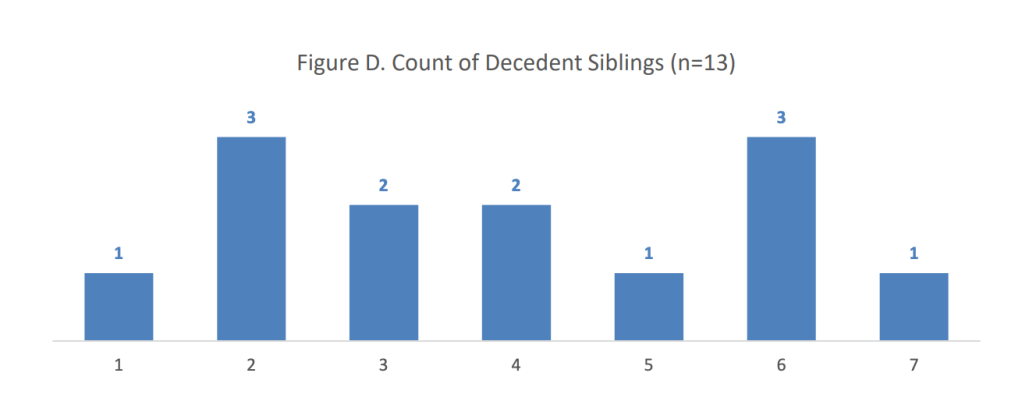
The children who died disproportionately resided in Ward 8 (seven children), Ward 7 (four children), Ward 5 (one child), and Maryland (one child). All of the children who died were African-American. None of these facts are surprising since they reflect the demographics of CFSA’s clients. Most of the children were living at home at the time of the fatality, except two that were living with relatives. All of the children who died had siblings. Nine of the decedents (about 69 percent) had three or more siblings; seven (54 percent) of them had four or more siblings, and four had six or more siblings. Many of the siblings were half-siblings. Twelve of the 13 decedents had at least one-half sibling.
Source: CFSA, Child Fatalities: Statistics, Observations, and Recommendations, 2019, page 6.

CFSA History

Over three quarters of the decedent’s families (10 families) had an open case or investigation within five years of the fatality. The other three families had one or more screened-out referrals only.

  • Six families had four or more reports to CFSA within five years of the child fatality. Nine families had two or more reports.
  • Eight families had at least one CPS investigation; of these families, one had a total of 10 investigations, another had seven investigations and two had five investigations.
  • All of these investigated families had at least one substantiated allegation of abuse or neglect. Most substantiations were for neglect; the neglect categories with the most substantiations were inadequate supervision and caregiver incapacity. There were two substantiations for physical abuse and two for “mental abuse.”
  • Of the eight families that had a CPS investigation, Family Assessment, or case closed within five years of the fatality, the time between investigation or case closure and the fatality ranged from four to 13 months.
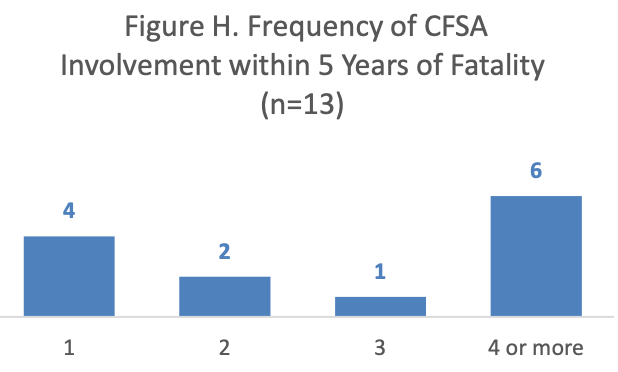
Source: CFSA, Child Fatalities: Statistics, Observations, and Recommendations, 2019, page 14. The frequency of CFSA involvement refers to the number of hotline reports received.

Four of the 13 decedents’ families (31 percent) were involved with CFSA at the time of the child’s death. All of these families had open Permanency (foster care) cases. According to additional information provided by the agency, one of these children, a three-year-old, was in foster care with a relative. Her death was classified as an abuse homicide due to blunt force injuries, but it was not known if the injuries were caused by the relative or another adult in the home. Another decedent, a 17-year-old male, had run away from foster care and been missing for 17 days when he was shot to death. The other two decedents were living at home at the time of their deaths: one was an accidental death (asphyxia due to unsafe sleep) and the other decedent’s manner of death was undetermined. According to additional information provided by the agency, in both of these cases the non-custodial parent lived in a different household and had an open permanency case for the decedent’s half-sibling.

CFSA’s Recommendations

CFSA’s Internal Child Fatality Review Committee (ICFR) makes recommendations based on the information it reviews; these recommendations are approved by the Agency Director. There were surprisingly few recommendations based on 2019’s child fatalities. One of them calls for the agency to “ensure that practitioners identify and evaluate all adults living (or potentially living) in the same home as a child in foster care.” CFSA’s Communications Director told Child Welfare Monitor DC that a three-year-old decedent in kinship care died of blunt force trauma that may have been inflicted by an adult that was living in the home. Based on the recommendation, we can assume that adult was not evaluated as part of the foster care licensing process. During my tenure as a social worker in foster care, foster parents (including kin caregivers) not informing their licensing agencies of adults living in the home was a common concern. Often this information is purposely kept from social workers because the adult (often a boyfriend) has a criminal or child abuse record that would prevent the home from being licensed. To address this problem, CFSA plans to have supervisors “continue to work with social workers to identify adults who live in or spend significant time in the home and ensure all adults are evaluated.”

Analysis

This report raises many issues and concerns. These include the exclusion of 20 cases from years prior to 2019, the many children who died of causes that might have been prevented by CFSA, the deaths of children in families with long histories of CFSA involvement, the large size of many decedents’ families, and the possible role of an uncleared adults in the home in a child fatality.

Scope and Coverage of Report: While the ICFR Committee reviewed 33 fatalities during 2019, the report covers only those 13 fatalities that actually occurred in 2019; all of the other 20 occurred in prior years, mostly 2017 and 2018. Unless CFSA returns to its earlier practice of including all fatalities reviewed in a calendar year in that year’s report, these 20 fatalities will never be covered in a future report. This is the first year the ICFR left out all deaths that did not occur in the same year as they were reviewed. Like the citywide Child Fatality Review Committee, until this year the ICFR reported on all of the fatalities it reviewed in a calendar year–not just the ones that occurred in the same year they were reviewed. Leaving out more than half of the fatalities of children known to CFSA in its annual fatality report every year deprives the public, policymakers and stakeholders of crucial information that, if acted upon, could help prevent fatalities and harm to children in the future.

Lack of Case Detail: The lack of detail on the individual cases is a major problem in making sense out of the information provided in this report. Statistical data on such a small number of cases is of limited utility, but knowing the history of CFSA involvement in each case would enable readers to pinpoint the opportunities that may have been missed to prevent the fatality and lessons for the future. The public should know such details, as long as personal information redacted. Some states, like Texas, Florida, and Washington are required to post fatality reviews for children who died of abuse or neglect following involvement with the child welfare agency, as described by Child Welfare Monitor. Detailed fatality case studies on child deaths with agency involvement (without identifying information) are provided in other jurisdictions by independent agencies like the Office of the Child Advocate in Rhode Island and Connecticut and the Inspector General for the child welfare agency. Legislation to establish an independent Ombudsperson for CFSA was introduced in 2019 by Councilmember Brianne Nadeau. Such fatality reports were not included in her original legislation, which was never put to a vote, but could be added to the next version.

Cause of death and preventability: The cause and manner of death were known in 12 of the 13 cases and were distributed evenly between four categories–natural causes, accidents, abuse homicides, and non-abuse homicides. The deaths from natural causes were very likely not preventable by CFSA action. Deaths in the other three categories, however, could possibly been prevented if CFSA had responded differently to these families when they came to the agency’s attention. Clearly the fatalities from abuse or neglect raise the question of whether CFSA terminated its involvement without ensuring that the maltreatment that led to the initial allegation had ended. Accidental deaths can reflect neglect. For example, all of the accidental deaths in this report reflected unsafe sleep practices..

Preventability of non-abuse homicides: We don’t know the details on the tragic deaths of an 11-year-old, a 16-year-old and a 20-year-old of non-abuse homicide. Was the youngest victim (most likely an innocent bystander and possibly the case that appeared in media reports in June 2019) exposed to violence because of the lifestyles of the adults who were caring for him? Were the two older youth themselves involved in violence and criminal activities, as is the case for many young victims of violence? Three of the families were involved with the Department of Youth Rehabilitation Services (DYRS), suggesting that one child (perhaps not the decedent) in those families was involved in illegal activities. I spent five years working as a social worker in foster care and almost four years serving on the citywide Child Fatality Review Committee. In this work I have seen numerous examples of young people who became involved in crime and violence after growing up in families that were repeatedly involved in child welfare due to drug activity, domestic violence, mental illness, and abusive or neglectful parenting. Cases were opened and closed, and children were in and out of foster care, but none of these interventions resulted in any substantial change in parental behavior. Perhaps some of these tragic deaths could have been prevented if better, more intensive and long-lasting services had been provided to the parents, or if the children had been removed from these homes after their parents failed to take advantage of offered services.

Families with Repeated CFSA Involvement: It is clear from the extensive history of some of these families with CFSA that the agency is failing to identify some children who are in danger in their homes. Some investigations may fail to identify the family’s most severe problems; some cases may be opened for foster care or in-home services but may close before the parents succeed in changing their behaviors. CFSA requires a “4+ staffing” for all families that have four or more allegations with the last report occurring within the past 12 months. There was concern in previous years that families with child fatalities had more than four allegations but there was no documentation of a 4+ staffing. As a result, ICFR in 2018 recommended that the agency “make 4+ staffings more consistent,” a recommendation that was reported as “complete” in this year’s report. CFSA reports that five of the families with a child fatality in 2019 were eligible for a 4+ staffing. Of these families, four were documented as receiving such a staffing, but there was no explanatory documentation for the family that did not receive one. If the agency is indeed more consistently holding these meetings, it may be time to evaluate their effectiveness.

Unknown adults in a kinship home: Information provided by CFSA indicates that one of the abuse homicides was perpetrated in a kinship home and that it is not clear whether the perpetrator was the relative or another adult in the home. Evidence suggests that many abuse homicides are perpetrated by other adults living in the home, particularly nonparent partners, as described in Within Our Reach, the report of the Commission to Eliminate Child Abuse and Neglect Fatalities.

Large families: There is considerable evidence that the deceased children tended to come from larger families. Not only did 70 percent of the decedents have three or more siblings but more than half of the decedents had four or more siblings. The average number of children in a family is only 1.9 in the United States. Large numbers as well as close spacing of children are correlated with more abuse and neglect. Many of these mothers started having children as teenagers. Often, the medical providers used by low-income women lack access to the more modern, effective modes of contraception such as Long Acting Reversible Contraceptives (LARC’s) at all, or require a second visit to obtain these methods.

Recommendations

  1. Cover all fatalities reviewed: CFSA should return to its previous practice of covering all deaths of children known to CFSA within five years–not just those that took place in the year of review. This would probably at least double the number of cases included, providing a much larger basis for making conclusions.
  2. Provide detailed case studies by a neutral party: The public needs to have access to a detailed case study of each fatality in a family with which CFSA had recent involvement. Such a case study would include a chronology of agency involvement and a description of touchpoints where the agency could have done something different and perhaps averted the death. This is particularly important for legislators, who might want to take action to avert future deaths, and for members of the media, who are often the ones that make the public aware of gaping holes in our child safety net. Ideally, such an analysis would be performed by a neutral party, such as the child welfare ombudsman’s office that was proposed last year.
  3. Pay attention to those with repeated CFSA reports: CFSA should assess the nature of the 4+ staffings to determine whether they are having any impact on families with multiple allegations, whether the current guidance for such meetings needs to be changed, and whether other measures should be implemented to ensure that families with repeated allegations get more attention.
  4. Evaluate all adults in the home: The IFRC suggested that the agency “ensure that practitioners identify and evaluate all adults living (or potentially living) in the same home as a child in foster care.” To implement this recommendation, the report states that CFSA plans to have supervisors “continue to work with social workers to identify adults who live in or spend significant time in the home and ensure all adults are evaluated.” More specific guidance may be needed for supervisors and workers as to how to identify such adults.
  5. Increase access to effective birth control methods: The large size of many decedents’ families highlights the need for policies to increase access to modern, effective and long-acting birth control options for all women in the District. Some of the saddest moments in my life as a foster care social worker came from hearing that a mother struggling to get her existing children back from foster care was pregnant again. Clearly expanding access to family planning is in the bailiwick of the Department of Health (DOH) rather than CFSA. However, even in the absence of DOH initiatives, CFSA could collaborate with DOH to ensure that the parents involved in cases have access to effective contraception as soon as their cases are opened and are educated about the deleterious effects of close child spacing and large families, and that family planning is included in case plans.

Studying fatalities among children known to a child welfare agency is an important way to find out how well an agency does its job of protecting children and to suggest changes to protect children better in the  future. CFSA’s review of a limited number of child fatalities (probably less than half) among children known to CFSA in FY 2019 suggest that the agency could have done more to identify and protect some children in danger. And for every dead child, several more may be suffering from abuse and neglect that will poison their future. Leaving out over half of the children whose deaths were reviewed in 2019 just because they died in previous years is an unnecessary loss of information that could be crucial in saving lives in the future. And without a detailed study of each case, it is impossible for legislators and members of the public to evaluate whether CFSA did all that it could to prevent these deaths and protect the many other children in these homes.

This post was modified on October 15, 2020 to incorporate new information provided by CFSA on the families of decedents who had open permanency cases as well as to modify a statement regarding the scope and coverage of the report.

CFSA hotline calls, investigations and substantiated maltreatment reports plummeted under Covid-19 shutdown

Report Child Abuse—It's the Law | Attorney General Karl A. Racine

Last spring, reports poured in from around the country about drastic drops in calls to child abuse hotlines after the closure of schools due to Covid-19 and the loss of reporting from teachers and other school personnel. The District of Columbia was no exception, and Child Welfare Monitor DC shared early data from the Child and Family Services Agency (CFSA) that documented a dramatic decrease in the number of hotline calls in the first month of the lockdown compared to the same period of the previous year. CFSA has finally uploaded data for the entire third quarter–April through June 2020–to its online Data Dashboard. This newly available data confirms the drastic decline in reports, investigations, and substantiations under the Covid-19 emergency.

The loss of reports from schools was the primary explanation for the drops in reports of child maltreatment around the country last spring. And indeed the shift to online education delivered a double blow to child protection efforts. For children who did attend virtually, it was harder for teachers to see signs of trouble, like bruises or hunger, than it would be in person. But many children were absent from digital classrooms much or all of the time. DCPS did not collect data on school participation last spring. But 57 percent of the 2,000 teachers who responded to a survey by the Washington Teachers’ Union, said that less than half their students were participating in virtual education. A child’s failure to participate may reflect the lack of a dedicated computer or internet access, difficulties in accessing platforms, a child too busy watching siblings or even working, or lack of engagement in virtual education.  Whatever the explanation for their absence, these children were not being seen by teachers, counselors or other school staff, often the ones who notice red flags. Other potential reporters, like doctors and extended family members, were also less likely to see children under the Covid-19 stay-at-home orders. 

In the District, schools closed for in-person classes on March 13, 2020. After a two-week spring break, online learning began on March 24 and ended on May 29, nearly a month early. So any effect on hotline calls should be observed starting in mid-March and ending in late June, when schools would normally close. To assess the effect of the school closure and health emergency, we compared the numbers of reports, investigations, dispositions, and foster care placements in the third quarter of 2020 (or April through June 2020) with the numbers during the same period of 2019.

The difference between the third quarter of 2020 and the same period of 2019 was staggering, as shown in Figure I. There were only 2,231 calls to the CFSA hotline between April and June 2020, compared with 6,058 during April to June 2019. That is a decrease of 63 percent. Unfortunately, CFSA does not provide quarterly data on the reporting source, so it is not possible to see which reports declined most. But if it the District is like other jurisdictions, school personnel probably accounted for a large fraction of the drop. The District’s drop in hotline calls may be even more pronounced than the national trend due to the District’s emphasis on school reporting of student absences before the pandemic, according to Judy Meltzer, President of the Center for the Study of Social Policy, who has followed CFSA for many years as the Court Monitor in its longstanding class action suit.

Calls to the hotline can be screened out as inappropriate, treated as “information and referral,” or result in investigations. The number of investigations dropped from 1773 in the third quarter of FY 2019 to 842 in the third quarter of FY 2020– a decrease of 52 percent–as shown in Figure 1. The fact that investigations decreased by a lesser percentage than hotline calls reflects the fact that hotline calls were more likely to result in investigations in 2020 than in 2019. The percentage of hotline calls resulting in investigations increased from 29 percent to 38 percent between the third quarter of 2019 and that same quarter of FY 2020. This suggests a trend that has appeared in other jurisdictions where data on referrals has been analyzed in detail. These analyses reveal that the reports made during the lockdown tended to be more serious, with the less serious reports more likely not to be made, as reported in our national blog, Child Welfare Monitor. This may be happening in the District, but the drastic drop in reports overall indicate that complacency is not in order. Clearly many serious referrals are being missed along with the less serious ones.

An investigation can have several possible results. It can result in a finding of “inconclusive,” meaning the evidence is insufficient to prove maltreatment despite some indications it occurred; “unfounded,” which means “there was not sufficient evidence to conclude or suspect child maltreatment has occurred;” or “substantiated,” indicating that the evidence supports the allegation of maltreatment. (See the CFSA Data Dashboard for the definitions of these terms as well as of another category called “incomplete investigations.”) There were 381 substantiated investigations between April and June, 2019, and there were only 214 substantiated investigations in the same period of 2020, representing a decrease of 44 percent. (See Figure I). Just as the number of investigations decreased by a lesser percentage than the number of reports, the number of substantiated investigations decreased by a lesser percentage than the number of investigations overall. The percentage of investigations that was substantiated increased from 21 percent to 25 percent between 2019 and 2020. Again, this may represent a tendency for the reports that come in to be more serious when school was virtual.

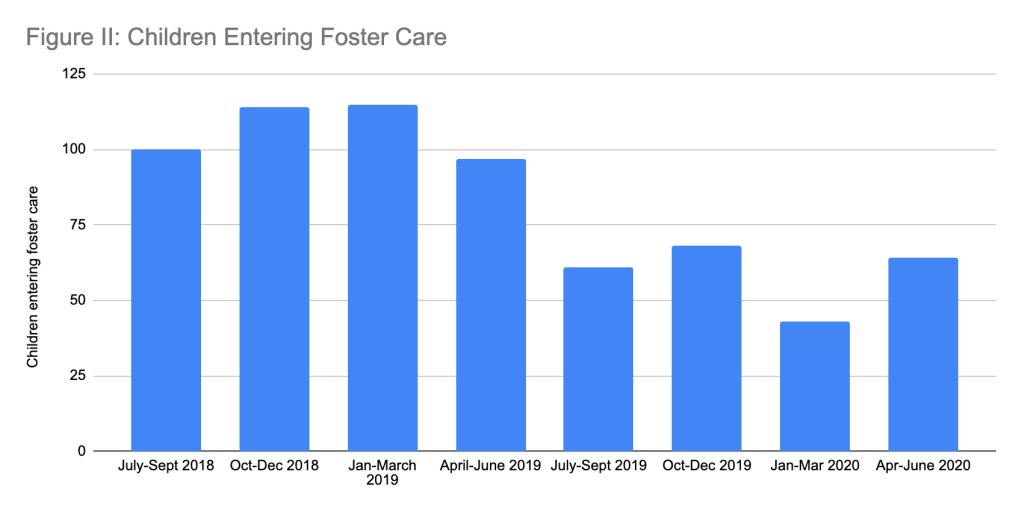
When an abuse or neglect allegation is substantiated, several things may happen, depending on the level of risk to the child or children in the home. The agency may take no action, refer the family to a community-based collaborative, open an in-home case, or place the child or children in foster care. Like hotline calls, investigations and substantiations, the number of children entering foster care plummeted during this quarter–from 97 in the third quarter of FY 2019 to 64 in the same period of 2020–a decrease of 34 percent. This percentage decrease, though large, is clearly smaller than the decreases in hotline calls, investigations and substantiations. Moreover, foster care entries began dropping precipitously before the pandemic hit, starting in the fourth quarter of FY 2019, as shown in Figure 2. During that period only 61 children were placed in foster care, 39 percent less than the 100 children placed in the same quarter of FY 2018. In the first quarter of FY 2019, 68 District children were placed in foster care, 40 percent less than the 114 children placed in the same quarter of the previous year. In January to March of 2020 (which saw the only the very beginning of the Covid-19 emergency), foster care placements fell by nearly two-thirds compared to the same quarter of 2019–43 compared to 115–truly the most surprising and confounding number in the graph. But in the first full quarter of the pandemic emergency, April through June 2020, 64 children were placed in foster care–almost 50 percent more than the previous quarter.

Thus, it appears that the decline in foster care placements during the pandemic emergency was actually a continuation of a trend that started earlier–and was more precipitous before the emergency than during it. When we asked CFSA about this, Communications Director Kera Tyler responded that the fall in foster care caseloads reflects CFSA’s continued commitment to keep children out of foster care by supporting families in their homes. “CFSA is committed to front-end operations to better support families with the goal of keeping them together without formal child welfare involvement whenever it’s safe to do so. In keeping with our Four Pillars strategic framework, we’ll continue to narrow the front door by linking families to community-based services that help to keep children in their homes.”

“Narrowing the front door” was the first pillar of the Four Pillars Strategic Framework instituted in 2012 by Brenda Donald in her first term at the Director of CFSA. It referred to the effort to support families so that children could remain safely at home. The number of children in foster care on the last day of the fiscal year declined every year between FY 2009 and 2019, falling from 2264 in 2008 to 798 in 2019. The decline appeared to be leveling off in Fiscal Years 2017 and 2018, but there appears to have been a renewed push to narrow the front door starting in the fourth quarter of Fiscal Year 2019. It is impossible to disentangle this trend from the effects of school closures and overall lockdowns, except to say that the downward trend in foster care placements actually moderated in the spring quarter.

The pandemic-induced reduction in calls, investigations, and substantiations remains equally alarming when we know that more of the unseen children would have been remaining at home with services rather than removed to foster homes. Because these children are invisible to the system, their families are not receiving the services they need to keep their children safe. And by the time these children are discovered (perhaps not until school buildings open again), conditions may have deteriorated to the extent that the children must be removed.

With school starting online on August 31, the need to find these unseen children is more urgent than ever. So what can be done? We have published a detailed list of suggested approaches, with examples and links, in our national blog, Child Welfare Monitor. These suggestions are listed briefly here.

  1. Public awareness campaigns using mailings, posters, and social media to remind community members to report any suspicion of abuse or neglect. The CFSA hotline was included on a postcard that also includes hotlines for Adult Protective Services and the DC Victims hotline. CFSA could do more by developing resources that provide more detailed information about signs of child abuse and neglect.
  2. Providing guidance to teachers and other traditional reporters on how to to spot signs of abuse and neglect in virtual settings: Many excellent materials are available and cited in the Child Welfare Monitor article. They provide some very helpful tips and warning signs for teachers to look out for, and parental behaviors to anticipate and try to prevent, like excessive punishment for children who receive a bad grade.
  3. Reaching out to nontraditional reporters, like animal welfare workers, postal workers, garbage collectors, and home repair specialists: These workers continue to see children and should be educated about signs of child abuse and neglect. The idea of partnering with animal protection organizations is particularly interesting. Animal abuse often coexists with child abuse, and encouraging information-sharing between the two systems is a promising idea that should be explored.
  4. Reaching out to at-risk families known to the system: Michigan and Allegheny County, Pennsylvania contacted higher-risk families with child welfare cases that recently closed to offer help with urgent needs, thus addressing stress and social isolation, which are major correlates of abuse and neglect. Many parents were very appreciative and eager to talk, and social workers reported some success in connecting them with services and benefits.
  5. Investing in Prevention: When it is harder to identify existing abuse and neglect, it makes sense to invest in preventing it. This is already a high priority for CFSA, which is establishing neighborhood family support centers. However it is our view that a more targeted, intensive approach that can be adapted for virtual use during the pandemic is called for. CFSA should look some programs currently under development in other jurisdictions, such as Allegheny County’s Hello Baby Program, which is universal but targets more intensive services to the families most at risk, and Michigan’s new pilot program pairing at-risk families with peer counselors and benefits navigators. These programs use predictive analytics or historical data to target the families most in need of help to prevent child maltreatment.
  6. The role of schools:: Ensuring children’s attendance in virtual education is not important only to prevent them from falling behind in school but also to fulfill the schools’ role as a protector of children. Unseen children cannot be protected. Video screens provide some opportunity for teachers to spot problems. We know that DC Public Schools were not successful last spring in getting computers and high-speed internet to all the children that needed them. The chancellor has promised to do a better job this year, but on the eve of opening day it was clear that many students still lacked a computer or an adequate internet connection. The schools must also do a better job of tracking attendance and reaching out to children who are not logging into school platforms. One Arlington County elementary school principal has directed teachers to provide the names of children who have not logged in by noon every day. Teaching assistants and other staff will reach out to these children and help resolve any problems until all students are engaged in school. DCPS and charter schools should adopt such a policy. They should also explore the possibility of adding to virtual platforms a button that children can push if they need help if there is trouble at home.

The District, like other jurisdictions, has seen a dramatic drop in calls to the child abuse hotline, resulting in a corresponding fall in investigations and substantiated allegations. These sobering statistics suggest that many abused and neglected children are currently invisible to the systems that exist to help them. CFSA and DCPS must take action quickly to identify these children; and CFSA should also develop more targeted efforts to prevent child abuse and neglect among at-risk families.

More efforts needed to encourage child abuse reporting during pandemic

CFSAhotlineSocial distancing is essential to break the back of  the coronavirus pandemic. But for children who are at risk of abuse and neglect, social distancing can mean being cut off from the people who might see and report their situation. The District’s Child and Family Services Agency (CFSA), like other agencies around the country, has recognized the problem. However, its response should be strengthened in order to check in with isolated children before schools close on May 29.

All DC public schools (DCPS) and public charter schools closed on March 16. Public schools resumed on March 24 and charter schools on various dates with instruction taking place by distance learning. Distance learning will continue until DCPS schools close on May 29, weeks before the regular closing date. Each public charter school is selecting its own end-of-year closing date.

We do not know how many children are logging on but we know there are problems. The coronavirus crisis has highlighted the digital divide that already affected the District. This divide coincides with discrepancies in income, parental education, time and many other resources affecting children. DCPS estimates that 30% of its students lack a computer and/or access to the internet at home. As the Washington Post has reported, schools, nonprofits and activists have been trying to fill the gap but have not reached all the children who need help getting connected with their schools.

The results of the digital divide are clear. The Washington Teachers’ Union surveyed its teachers in April and received responses from about half of all teachers, as reported in the Washington Post. Of the respondents, 57 percent said that less than half of their students were participating in virtual education. Not surprisingly, teachers at richer and more selective schools reported strong attendance in remote education. DCPS Chancellor Lewis Ferebee told the Post that “Ninety-six percent of our students have engaged in some way….And those are the key words here: ‘in some way.’ . . . Instead of logging into a learning session, a student may be doing virtual meetings with a counselor or a school psychologist.” But we have no idea how much contact those 96 percent of students have had with their schools. Was it one virtual contact or ongoing contact? Without knowing the quality or frequency of the contact, this figure is not very helpful, except to raise extreme concerns about the four percent of students who have had no contact with their schools since the shutdown.

Unfortunately, many of the children without computers and internet are also the most at risk for abuse and neglect due to poverty, parental drug abuse, domestic violence, or parental mental illness. Taking these children out of  school cuts them off from the main group of professionals on whom we rely to report their concerns about child abuse and neglect to child welfare agencies.

Hotline data show the impact of this loss of contact. CFSA reports that between March 16 and April 18 of 2020, it received 897 hotline calls, with 30 percent coming from school personnel. During the same period last year, the agency received 2,356 hotline calls, with 52 percent coming from school personnel, according to CFSA Communications Director Kera Tyler. Clearly both the number and proportion of calls coming from schools have declined greatly, but so has the number of calls coming from other sources. This is not surprising since other major reporters, like medical personnel and extended family members, are also less likely to see children during this period of social distancing. 

At the same time as hotline calls have drastically decreased, severe child abuse appears to be increasing. The Washington Post reports that “the overall number of children referred to Children’s National Medical Center with child abuse concerns has dropped. But the cases coming in are more severe than usual: From March 15 through April 20 of last year, about 50 percent of the children had injuries serious enough to be hospitalized. This year, 86 percent did. During the same period last year, about 34 percent of children had head trauma, fractures, or injuries in multiple areas of the body. This year, that number jumped to 71 percent. Last year, 3 percent of the children referred for child abuse died. This year, 10 percent died.” While teachers are unable to reach a student, serious injury or death is the worst-case scenario but they also worry about children being hurt, going hungry, and suffering other types of abuse or neglect.

On April 13, 2020, CFSA issued new guidance to educators who are concerned about their inability to contact some students. The guidelines create a dichotomy. between “contact concerns” and “safety concerns.” For children of any age for whom there are safety concerns, educators are directed to call the CPS hotline. For children aged 0-4 and 14-18 for whom there are “contact concerns,” educators are also directed to call the hotline.

But for children aged 5-13, there is a different procedure for when a school “determines it has not had sufficient contact with a student, and there is no evidence the student has engaged in distance learning.” In such cases, schools are directed to attempt to reach the student’s friends and emergency contacts and to use calls and postcards to contact the student and family members. After ten days of such efforts, schools that have been unsuccessful in reaching a student are instructed to complete a reporting form to CFSA. The guidance warns that any “report that does not document full contact efforts will be denied by CFSA and sent back to the reporting school.” (According to CFSA’s Ms. Tyler, these specific reporting requirements for children aged five to 13 derive from the law that requires reporting of unexcused absences for students in this age group and also from a concern that parents play a more important role in facilitating contact with school than for older children).

In view of the large decline in reports from teachers, one might worry that CFSA seems more concerned with restricting reports from teachers than encouraging them. When we raised this concern with Ms. Tyler, she stressed that the “most important piece of the guidance to note is that if educators have safety concerns for a child of any age, it is mandatory to report those concerns to the hotline.” When the concern is educational, the guidance encourages teachers to use different approaches to reaching students before engaging the hotline.

However, distinguishing between contact concerns and safety concerns is difficult in this time of social isolation. Lack of contact prevents the identification of safety concerns, and long-term lack of contact (when teachers have tried to reach students and their families by phone, email or mail) suggests a child may be in danger. The early closing of schools on May 29 of this year will leave children without even virtual conduct with the most important group of mandatory reporters. CFSA and DCPS should consider new guidance encouraging school staff to report on all students for whom contact has been a concern since the schools reopened in March. This should include all students with whom the schools have not been in touch since school reopened (the four percent mentioned by the Chancellor) as well as any students with whom there has been little or no recent contact and for whom teachers have reason to feel concern. Such guidance should request that schools reach out to these students and their families and to report to the hotline when such efforts have been unsuccessful.

CFSA has been making efforts to encourage other professionals to report. The agency has reached out to agencies like the Metropolitan Police Department and community organizations like the Healthy Families and Thriving Communities collaboratives to serve as “an additional set of eyes and ears” on children. CFSA has asked Child Welfare Monitor DC to share the following message: To help keep children safe during this time, it is imperative for neighbors, family members, and essential workers who still see children to be extra vigilant. CFSA is operating through the pandemic, and our hotline accepts calls 24 hours a day, seven days a week. Please call 202-671-SAFE[7233] to report child abuse or neglect.

CFSA could be more aggressive in sharing this message. The agency could work with the Mayor to incorporate messaging about child abuse and neglect reporting into her daily press briefings. The agency could try to reach the workers who are still seeing children and families by providing materials to grocery stores, pharmacies, post offices, and food banks to share with their employees informing them of the signs of abuse and neglect and how to report them.

As we approach the end of the school year, the emphasis should shift from setting limits on CPS calls to encouraging educators to reach out to all children and families with whom they have had little or no contact. It is a time for schools and CFSA to team up to check on our most vulnerable children before the the school year ends and the opportunity is lost. And it is also time for CFSA to look for other workers outside schools to take on the role of protectors of our children.

This post was updated on May 13, 2020 to incorporate information from a Washington Post report about school participation during the pandemic. 

Want a national perspective? Check out our national blog, Child Welfare Monitor

Enter your email address to subscribe to this blog and receive notifications of new posts by email.

Welcome to Child Welfare Monitor DC

Welcome to Child Welfare Monitor DC. Since leaving my job in the District of Columbia’s child foster care system in 2015, I’ve been writing about national issues in child welfare through my blog, now called Child Welfare Monitor. I have not focused on local issues, using my participation on the Citizen Review Panel for child welfare as the platform for my local child advocacy work. 

With my decision to leave the Citizen Review Panel, I’ve decided I needed a local platform to focus on specific issues around child welfare in the District and I’ve created Child Welfare Monitor DC. My goals are twofold.

  • First, in view of the almost total absence of press coverage of child welfare in the District, I want to inform people of about what’s going on in the District of Columbia child welfare system. In the coming months, I’ll write about CFSA’s implementation of the Family First Act, the upcoming  oversight and budget hearings, reports and hearings in the LaShawn case, and the suit filed by DC Kincare Alliance regarding CFSA’s use of kinship diversion, among other issues. I’ll cover new publications that come out of CFSA, new reports from the court monitor and other outside agencies and other resources, events and policy changes that won’t be covered anywhere else. 
  • Secondly, I want to convey my own unique point of view. Those of you who read Child Welfare Monitor will know that I take a child-centered approach to child welfare. I think that CFSA, like most other large systems, has gone too far in its focus on parents’ rights at the expense of child safety. I’m also concerned about foster care and the lack of parenting many wards of the state receive, whether they are in foster homes or other facilities. And of course I’m concerned about the current placement crisis, which would clearly be much worse if all the substandard foster homes were shut down. These and other concerns will come out in my writing, but if you disagree with me, I hope you will still appreciate the factual reporting that you will also find in my blog. 

If you want to know more about me, check out the About page of this website. And I hope you will subscribe to this blog by clicking on the Follow icon on the right-hand corner of my home page.

Marie K. Cohen