CFSA in FY2024: An alarming increase in incomplete investigations

Complete Fiscal Year 2024 data now on the Dashboard of the District of Columbia’s Child and Family Services Agency (CFSA) reveal significant changes over the previous fiscal year. Most striking is a large jump in the number of incomplete investigations and a concomitant decline in “substantiated” and “unfounded” reports. The number of children entering foster care increased for the first time in over ten years. There was a drop in in-home case openings but a similar increase in foster care placements during the year. The agency did not respond to this writer’s questions about the meaning of these trends.

Referrals

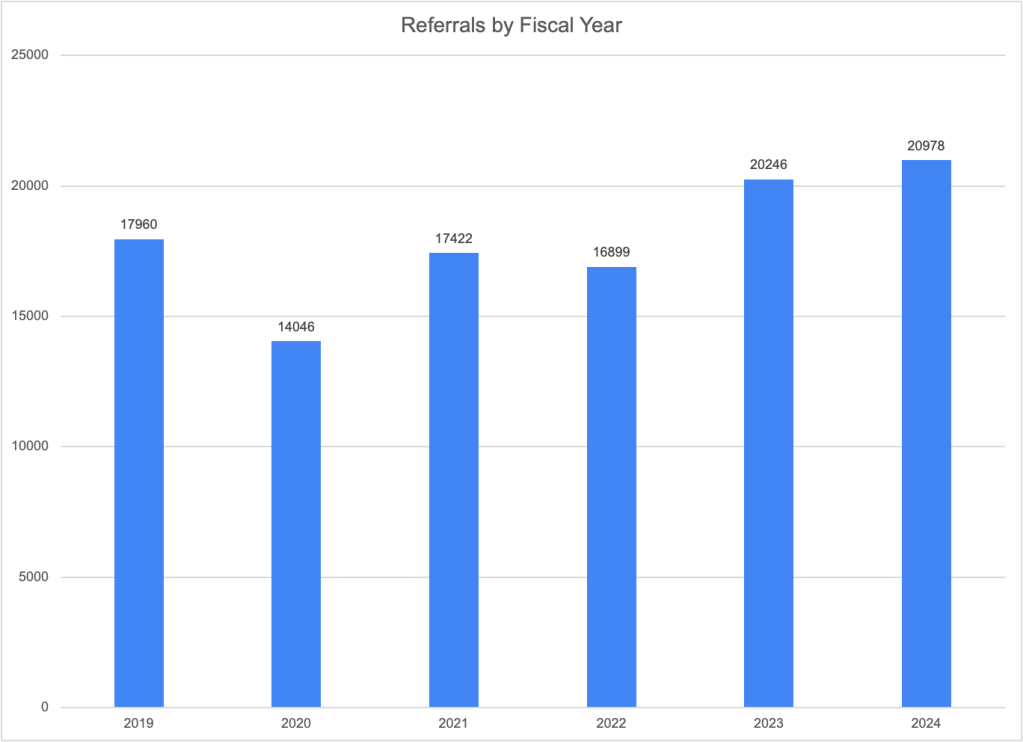
Total referrals (or calls to the CFSA hotline) have increased for the second year in a row. After falling in 2020 and remaining below 2019 levels in 2021 and 2022, the number of referrals jumped from 16,899 in FY2022 to 20,246 in FY2023 and then rose more modestly to 20,978 in 2024–an increase of 3.6 percent. Prominent child welfare scholars like Emily Putnam-Hornstein have concluded that referrals are the best available indicator of actual maltreatment due to the strong correlation between referrals and future reports (regardless of the outcome of any associated investigation) and also evidence of the difficulty of correctly determining whether maltreatment has occurred. Thus, the increase in referrals may well be a sign of increasing maltreatment. Contributing factors might be the end of COVID-19 assistance programs and the growing mental health, substance abuse, and housing crises in the District.
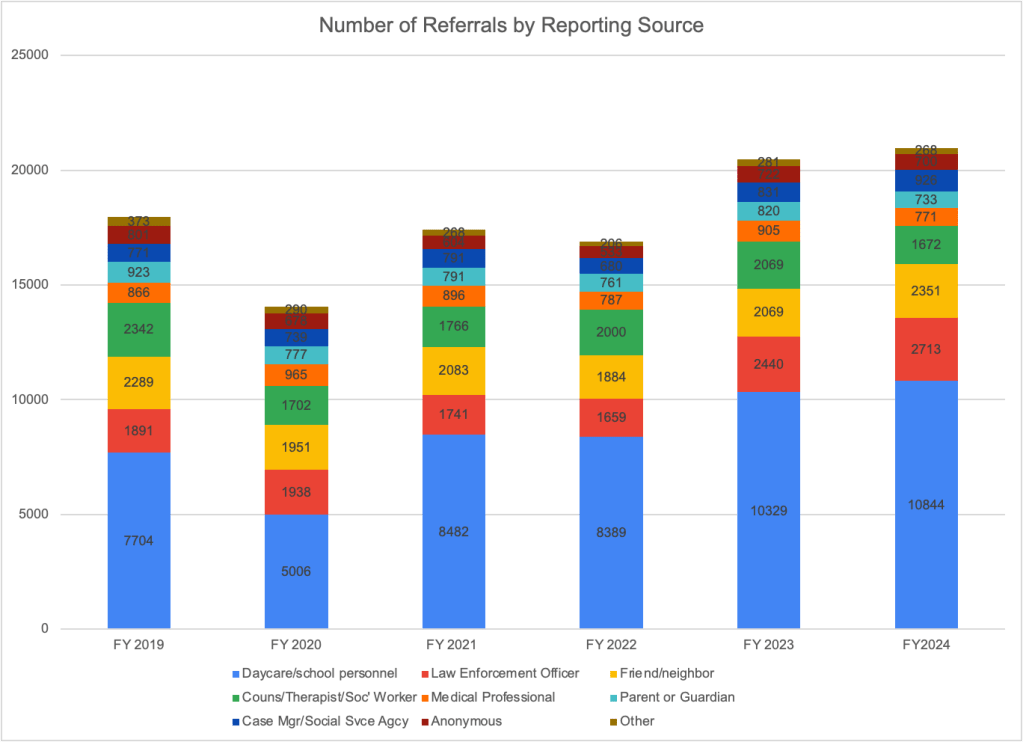
Childcare and school personnel continued to make more than half of the referrals to CFSA, with another 13 percent coming from law enforcement and 11 percent from friends and neighbors. All three of these groups made more referrals in FY2023 than FY2024, while counselors, therapists, social workers and medical professionals made fewer, suggesting that children may be seeing fewer of these professionals with the disappearance of virtual options spawned by the pandemic.
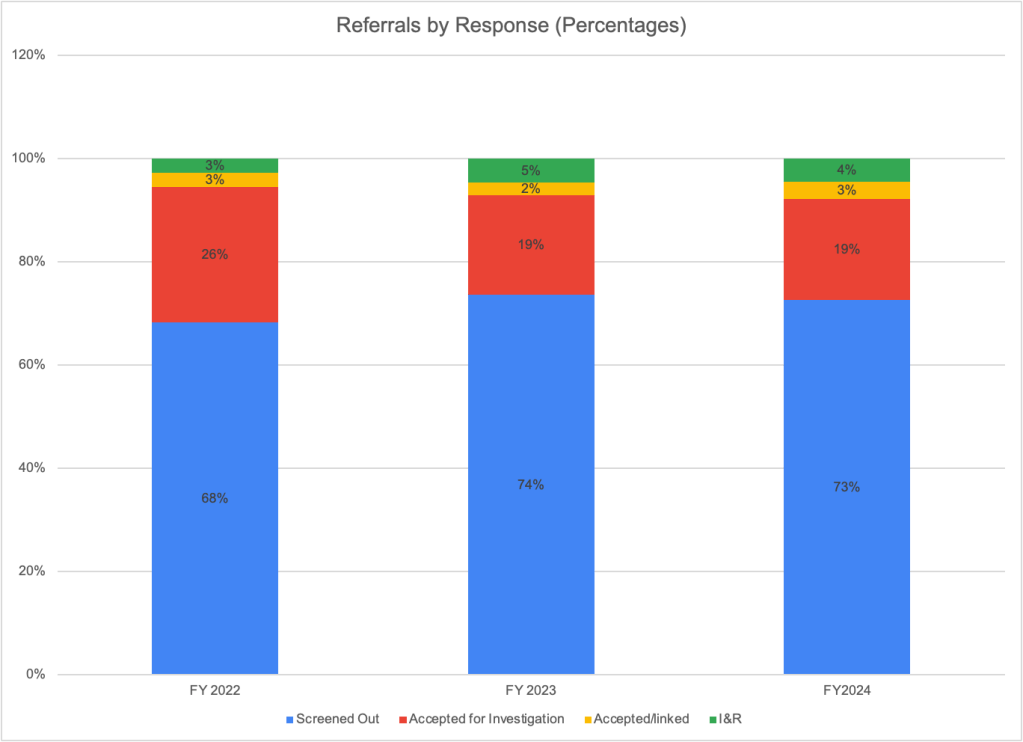
Looking at CFSA’s response to the referrals, the largest portion, or 73 percent, were screened out. That compares to only 19 percent that were accepted for investigation. The remaining referrals were either linked to an existing investigation (three percent) or classified as an information and referral that does not involve an allegation of abuse or neglect. These percentages are quite similar to those of the previous year.
Investigations

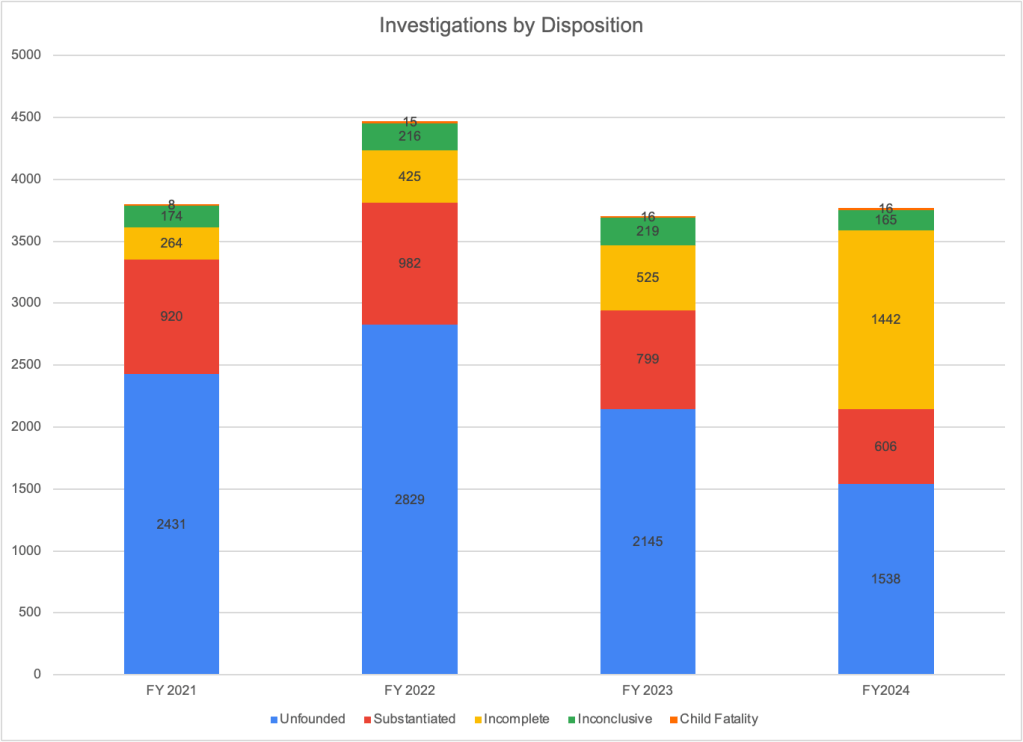
An investigation can have five different dispositions. According to the definitions provided in the Dashboard, unfounded means that there is not enough evidence to conclude that the child has been maltreated or at risk of being maltreated. “Substantiated” means that there is enough evidence to conclude that the child has been maltreated or is at risk of maltreatment. “Inconclusive,” means that “there is insufficient evidence to substantiate the report but there still exists some conflicting information that indicate the abuse or neglect may have occurred.” “Incomplete” means that the investigation could not be completed due to barriers like inability to locate the family, a family’s refusal of access to the home, or finding out that the family lived out of state.

There was a big jump in the number of investigations categorized as incomplete, from 525 in FY2023 to 1,442 in FY2024. That was an increase from 15% of all investigations to 38% of all investigations. As a consequence of the increase in incomplete investigations, the number and percentage of investigations that were unfounded and substantiated dropped drastically. The number of investigations that were substantiated fell from 799 (21 percent of investigations) in FY2023 to 606 (or 16 percent of investigations) in FY2024. Unfounded remained the most common disposition in FY2024, but the proportion of cases that were unfounded dropped from 58 percent to 41 percent.
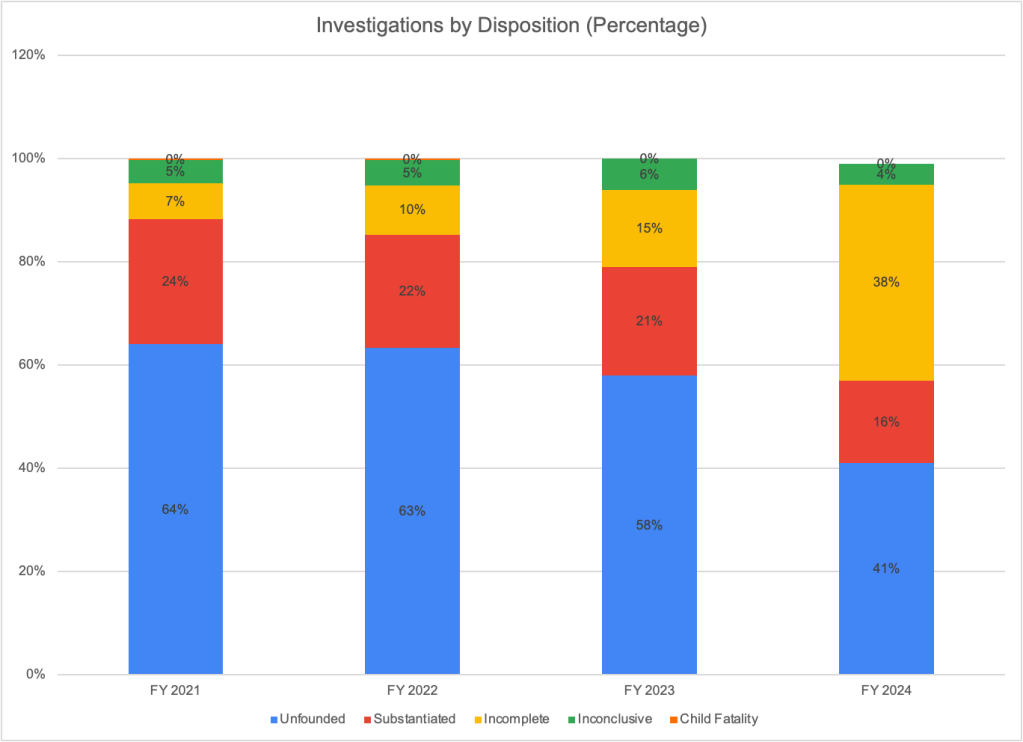
CFSA’s communications director did not respond to several emails asking for an explanation of the the jump in incomplete investigations. But it seems likely that this trend stems from the workforce crisis that is affecting CFSA and other child welfare and human services agencies around the country. A spreadsheet that the agency provided to the DC Kincare Alliance shows 27 out of the 36 social workers performing investigations as of August 2024 were carrying more than the 12 to 15 cases that CFSA uses as an indicator of satisfactory performance. This included 19 social workers carrying 20 or more cases and five social workers carrying more than 30 cases. Even more concerning is that the number of social workers doing investigations fell from 42 in January 2024 to 36 in August 2024, according to the spreadsheet. More concerning still, in its FY2024 Performance Oversight Responses, CFSA documented the caseloads of 90 social workers.

If social workers are not able to complete the required interviews and collect needed information timely, endangered children may suffer further harm. It is possible that most of the incomplete investigations have been essentially concluded with a determination of findings, leaving only the completion of needed documentation and forms undone as workers hurried to start new investigations. Such a scenario might be somewhat less alarming but would still raise concerns that overburdened social workers are not able to thoroughly investigate allegations, thereby endangering vulnerable children.

In-Home Case Openings and Foster Care Placements

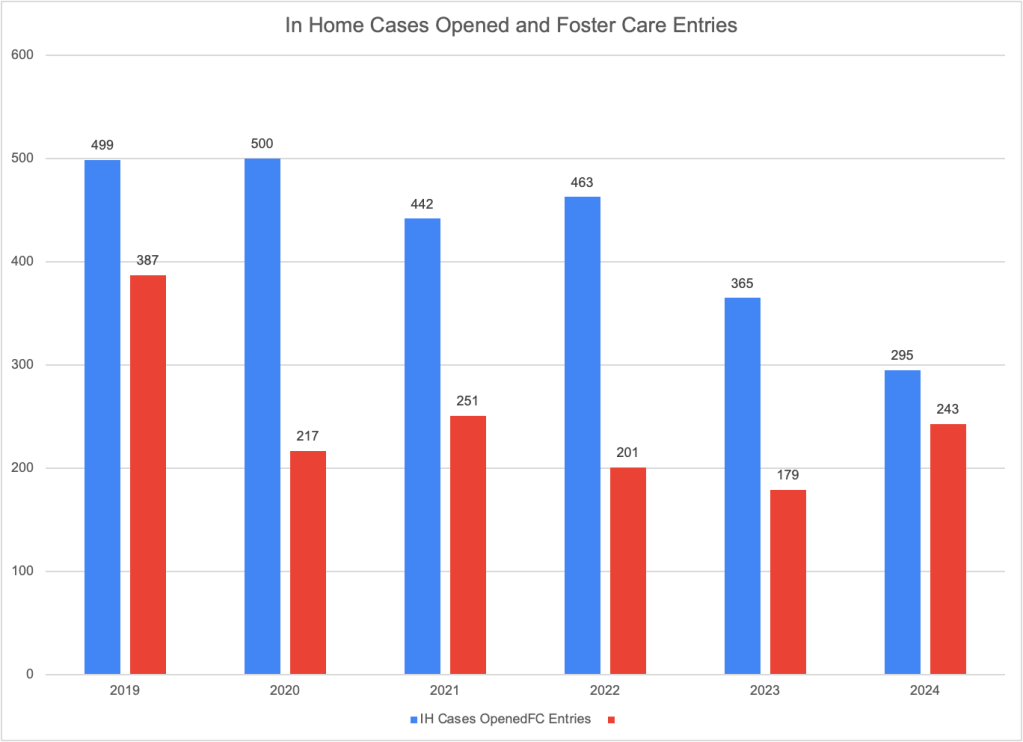
The table below shows the number of in-home case openings and children entering foster care by year. These two numbers cannot be added together because because in-home entries are reported at the case level (with multiple children in many cases) and foster care entries are reported at the child level. However the trends over time can be compared, showing that the number of in-home cases opened dropped between FY2023 and FY2024 while the number of children entering foster care increased. This was the first time the number of children entering foster care increased since FY2021, after the drop in foster care placement due to COVID-19.
The total number of children served in home and in foster care on the last day of every quarter are available on the CFSA Dashboard and can be added to yield the total number of children served on that date. The chart below shows that the total number of children served on the last day of the fiscal year (September 30) stayed basically the same between FY2023 and FY2024. But the number of children being served in their homes decreased by 50 while the number in foster care increased by 49. FY2024 reverses a trend of annual decreases in the number of children in foster care going back at least as far as 2011.
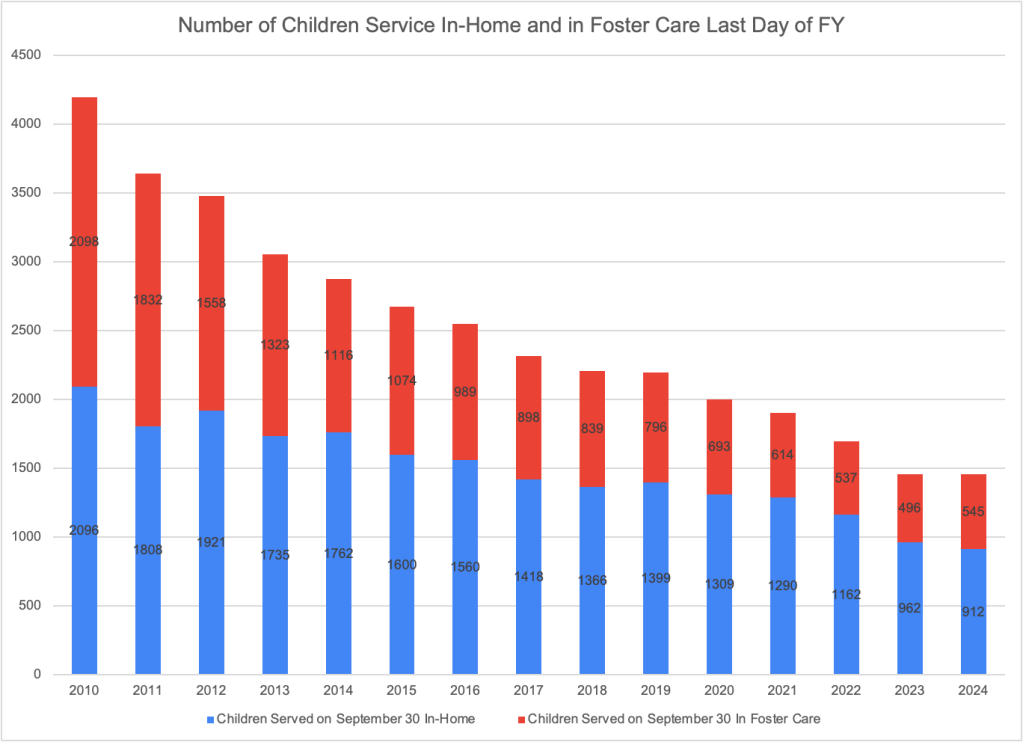
Source, For 2010-2023, CFSA Annual Needs Assessment, available from https://cfsa.dc.gov/sites/default/files/dc/sites/cfsa/publication/attachments/FY23_Needs_Assessment_and_FY25_Resource_Development_Plan.pdf; ,CFSA Dashboard for FY2024.

The increase in the number of children in foster care between September 30, 2023 to September 30, 2024 reflects an excess of entries to foster care over exits from care during FY2024. Specifically, the number of children in foster care at the end of the fiscal year should reflect the number of children in foster care at the end of FY2023, plus the number of entries to foster care during the year, minus the number of exits from foster care. While there is a discrepancy of two between the results of this calculation and the foster care caseload reported by CFSA, the numbers confirm that there were about 50 more entries than exits, so the caseload increased. A similar calculation cannot be performed for children served in their homes, as the entry data are based on cases, not children.

2023 FC Caseload2024 FC Entries2024 FC Exits2024 FC Caseload
496243196545

It may be reassuring that the number of children served by CFSA changed so little in FY2023. One can hope that despite the high percentage of incomplete investigations, CPS workers are doing what is necessary to find the children that need help and simply leaving some of the paperwork for later. However, such a situation is not sustainable without endangering children. And the 3.6 percent increase in the number of referrals between FY2023 and FY2024 was not met with an increase in the number of children served, which may be a result of the incomplete cases.


It is not possible to understand the FY2024 data without further information from CFSA. How alarming the increase in incomplete investigations may be depends on whether these investigations are truly incomplete or basically finished except for forms and documentation. More concerning still, CFSA caseload data indicates that there are fewer than half the number of social workers doing this work now than in previous years. It is good that the total number of children being served has not dropped precipitously along with the drop in completed investigations. But the public needs to know more about how CFSA is functioning and what it is doing to alleviate the workforce crisis
Relisha Rudd: new podcast misses crucial questions about her disappearance

Image: WAMU.org

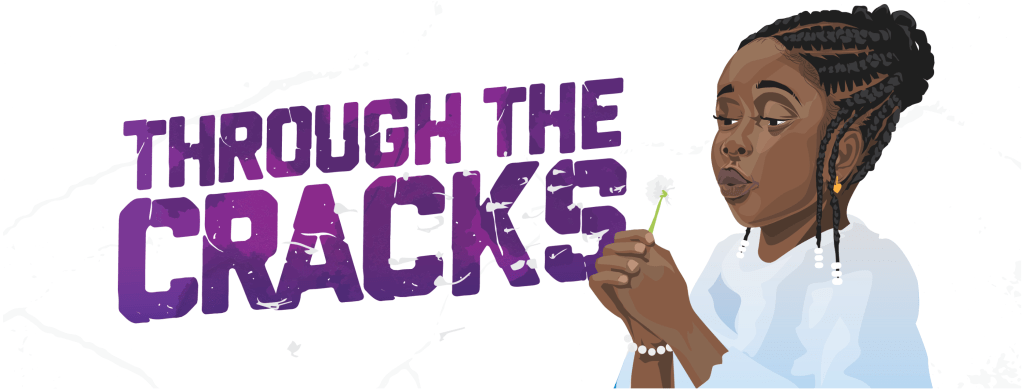
WAMU’s new podcast series, Through the Cracks, has just completed its first season, which focused on the disappearance of eight-year-old Relisha Rudd from the DC General family shelter in 2014. The podcast presents a compelling picture of how multiple generations of untreated trauma, combined with an inadequate social safety net, makes such tragedies possible. However, the podcast falls short in its effort to document the systemic failures leading to Relisha’s disappearance. Specifically, it draws an incomplete picture of the failure of DC’s Child and Family Services Agency (CFSA) to keep Relisha safe despite an open case on the family.

In Through the Cracks, host Jonquelyn Hill retells the story of Relisha Rudd’s 2014 disappearance, which many readers will remember well. By the time Relisha was declared missing, it had been 18 days since she was last seen at Payne Elementary School or the DC General shelter where her family resided, according to the podcast. After Relisha had accumulated 14 absences from school,[1] Payne’s social worker, LaBoné Workman, suspected anything was wrong with the excuse notes Relisha’s mother had been submitting, which were signed by a Doctor Tatum. When Workman arrived at the shelter to investigate, he quickly learned that no such Dr. Tatum existed. Instead there was a janitor with the same name. And not just an ordinary janitor. Investigators learned that Tatum had a criminal record that should have prevented his being hired to work at the shelter. Moreover, he had befriended many children and teens and given them gifts. Some parents had turned down the gifts and terminated the relationships, but not so Relisha’s mother, Shameka Young. The social worker’s visit touched off a citywide hunt for Relisha. On March 20, Kahlil Tatum’s wife was found dead of a gunshot wound to the head. On April 1, Kahlil Tatum was found dead from a self-inflicted gunshot wound. Despite extensive searching by police and volunteers, Relisha Rudd has never been found.

Through the Cracks explains how multiple systems set up to protect Relisha failed. Her mother and stepfather themselves survived instability, abuse, and trauma, which left them with issues that impaired their ability to parent her. Tenant protections failed to prevent the eviction of this family from their home. An abandoned hospital that treated homeless families like prison inmates became the family’s home. A predator named Tatum was hired at this shelter despite his criminal record.

But when it comes to the agency tasked with responding to abuse and neglect in the District of Columbia, the podcast missed the mark. In the penultimate episode, Hill finally mentioned that Relisha’s family was known to CFSA when she disappeared. In fact, she reported that Relisha’s mother Shameka Young was reported three times to the child abuse hotline–in 2007, 2010, and 2013. Hill noted that in none of those cases did the agency elect to remove any of her children, and she devoted some time to discussing that fact. She spoke with a CFSA official, and with Judith Sandalow of the Children’s Law Center, about the policies surrounding the decision whether or not to remove a child. Based on these conversations, Hill finally concluded that “…. because Relisha wasn’t taken away, I can infer that social workers didn’t find enough evidence of abuse or neglect, or I can infer that they believed they could solve whatever the issues were by offering solutions like affordable child care or parenting classes. And if that’s the case, I’m not sure what kind of follow-up there would have been.”

However, the Washington Post‘s extensive coverage of the case has already eliminated the need for some inferences. The Post reported that the abuse or neglect complaints mentioned above were all “sustained” or “verified” by the agency and provided further details. In July 2007, social workers reported finding “inadequate food and supervision for Relisha and her newborn brother and that Relisha had an injury that could have been caused by abuse.” In April 2010, workers investigating a complaint that Shameka failed to bring her son for a follow-up medical appointment after surgery found a home full of cigarette butts and trash and small children being allowed to bathe themselves “without supervision.” In the investigation of the 2013 call, a social worker noted that one of the children had been thrown to the ground, cutting open his lip, and slapped in the face. Young was stated to be “verbally abusive on a regular basis and would leave [the children] alone often.” The Post also explained that these three were the only reports to be sustained by the agency, but others may have been received as well.

Hill and her team could also have consulted CFSA about their options when abuse or neglect is found to have occurred. When CFSA finds abuse or neglect, it can take one of three actions: remove the child or children if they are deemed in imminent danger, open a case for in-home services if the risks are high for future harm to the child, or refer the family to a community-based agency for help if the children are not deemed at high risk. In the case of the 2013 call about Relisha’s family, we know what they did. They opened a case for in-home services.

Several pieces of evidence attest to the existence of an open case on Relisha’s family. Unnamed “sources” told NBC News that “D.C. Child and Family Services Agency (CFSA) had an active case working when Relisha went missing, along with three prior cases dating back to 2007.” (A reporter can actually be heard reporting this story in the background of the podcast.) The same information was implied by CFSA Director Brenda Donald in a Letter to the Editor stating that “the fact that CFSA does not remove a child as a result of a substantiated abuse or neglect allegation does not mean we do not provide any services.” The City’s heavily redacted report on Relisha Rudd also makes clear to anyone who knows child welfare that her family had an open case.[2]

The fact that a case was opened means that Hill reached some faulty conclusions. First, as explained above, the opening of a case means that the investigator did find abuse or neglect, contrary to Hill’s suggesting that was only a possibility. Second and more important, if Hill was indeed “not sure what kind of follow-up there would have been,” she only had to ask CFSA or the Children’s Law Center. A case for in-home services means there would be follow-up, including twice-monthly visits to make sure the children were all right and to assess the family’s compliance with their case plan. If things were not going well, the social worker had the option of removing the children or seeking court involvement to hold the parents accountable for changing their ways within a given period of time to avoid removal of the children.

Perhaps Hill and her co-producers fell victim to the common misconception that the primary function of child welfare agencies is removing children and placing them in foster care. In fact, as of December 31, 2014, CFSA was serving 2,812 D.C. children, of whom 62 percent were being served in their homes and only 38 percent in foster care. “In-home services” were the main vehicle for serving abused and neglected children in the District of Columbia. (The in-home percentage was slightly higher as of December 2020–about 65 percent). Then, as now, families with in-home services had a case plan outlining the steps they had to take (like receiving therapy or drug treatment) before the case could be closed. The social worker assigned to their case would have been required to visit them at least twice per month to monitor compliance with the case plan and to check on the safety of the children. That social worker would have been required to see each child on each of these visits.

The timeline provided by Through the Cracks indicates that Relisha was last seen on March 1, 2014 at a Days Inn with Tatum on video. (Police told the Post that she had been with him since February 26.) The school social worker’s visit to the shelter on March 19 touched off the citywide search for Relisha. If they had realized the significance of the in-home case, the producers of Through the Cracks might have wondered if the CFSA social worker visited the family late in February or between March 1 and March 18. If so, they might have wanted to know whether the social worker simply accepted Shameka’s claim that Relisha was safe in another location without seeing her, and if the social worker truthfully indicated that fact in her notes. Moreover, the Washington Post reported that Payne Elementary called the CFSA hotline on March 13, after she accumulated ten unexcused absences. A “person familiar with the case” told the Post that CFSA did not treat this as a high-priority call because Relisha’s brothers continued to show up at school. But this report should have been forwarded to the family’s in-home social worker and at least triggered a call or visit to the family by that worker. If they had read the article, the podcast producers should have wondered about that too.

Of course, it is clear that CFSA would not have answered any of these questions. NBC and the Washington Post cited leaked information from unnamed sources for their reports. CFSA refused to comment on Relisha’s case because it would violate the family’s privacy–the same response they give when asked about any individual case. But at least the podcast staff could have done a bit of digging, searching for someone who has left the agency since 2014 and might be willing to talk. They might have asked their police sources if the social worker had been interviewed. In any case, they could have discussed CFSA’s confidentiality protections and whether they truly protect families or serve primarily to serve the agency. And they could have at least raised the issue of CFSA’s how in-home services are supposed to work to address abuse and neglect while keeping children safe at home, and what changes might need to me made to make them more effective.

Why is it important to know how Relisha was able to fall through the cracks of CFSA? It matters because CFSA was Relisha’s last safety net. After tenant protections, the shelter, and the school failed, the only system left to save Relisha was CFSA. And CFSA continues leaving children in homes where they have been abused or neglected under the assumption that they will be safe with monitoring and services. If a child could disappear from a family that had such a case, then there was obviously a need for change. And indeed, the District recognized this. In the heavily redacted report on Relisha’s case that was released by the District government, many of the findings and recommendations concern CFSA (even though that must often be inferred in the findings, where the agency’s name is often redacted[2]), suggesting the agency should have done a better job of recognizing the family’s problems, sharing information with other involved agencies, and perhaps intervening more intensively by seeking court involvement or removing the children. Available information incidentally casts doubt on whether the recommended changes were actually made or retained, but that is beyond the scope of this post.

One hopes the failure to investigate CFSA’s failure in Relisha’s case was not a reflection of ideology on the part of Hill or the Through the Cracks team in general. In the podcast, Hill states that “Black mothers are so often gleefully blamed when things go wrong for their children.” It may not be an accident that she never specifies the details of the three founded reports against Shameka Young. Hill and her team did not mention the details of these findings, such as Shameka cursing her kids, splitting her son’s lip, and letting small children bathe alone. Were these details excluded so as not to make Shameka look bad? Did did the podcast team fear that saying CFSA should have assumed a more interventionist posture would go against the current child welfare climate and the growing movement urging child welfare agencies to stop policing black families, regardless of whether their children need protection?

The unifying theme of Through the Cracks‘ first season is the question of whether Relisha’s disappearance could have been prevented. The producers point out the irony of the District’s statement that the abuse could not have been prevented, while recommending a long list of changes to the policies and practices of all the agencies that interacted with the family. They rightly question the logic of exonerating DC agencies while telling them to change their practices. It is unfortunate that they missed the opportunity to explore the ways in the city’s child welfare agency failed to fulfill its duty to protect Relisha.

[1] According to the Washington Post, on March 13, Relisha had 10 absences and the school called CFSA. On March 19, Relisha had (by deduction) 14 absences and the school social worker went to the shelter.

[2] On page 4, “child welfare” was obviously redacted from Finding #1 and on page 5, “CFSA” is obviously whited out in Finding #2.